Why your booking amount stops at 10%
Every developer knows the booking amount is about 10%. Fewer treat it for what it is: a rule about timing. Section 13 of the RERA Act doesn't say what a flat should cost or how a payment plan should look. It says that until one piece of paperwork exists, you can't collect more than a tenth of the price. Everything after that waits.
That makes the speed at which you register agreements a cash-flow question, not a legal chore.
What Section 13 actually says
Section 13(1) is one sentence. A promoter "shall not accept a sum more than ten per cent. of the cost of the apartment, plot, or building", as an advance or an application fee, "without first entering into a written agreement for sale with such person and register the said agreement for sale ...".
Two words in there do the work. Written: a verbal understanding or a receipt is not an agreement. Register: signing is not enough. The cap lifts when the agreement is registered, not when the buyer puts pen to paper.
Section 13(2) then says what the agreement has to contain. Among other things, it must specify "the dates and the manner by which payments towards the cost of the apartment, plot, or building ... are to be made by the allottees", the possession date, and the interest rates either side pays on default.
Read together, the two halves give you the whole shape of a payment plan:
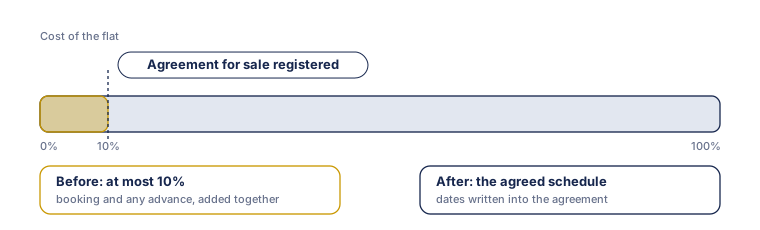
Up to 10% before the agreement is registered. After that, whatever schedule the registered agreement itself sets out.
A Letter of Intent does not change the count
The way developers get into trouble here is rarely a deliberate grab. It is usually a document that feels like an agreement but isn't one.
LiveLaw reported in April 2024 on a Maharashtra Real Estate Appellate Tribunal ruling in Kakad Housing Corporation v. Rajkumari Singh. The builder had issued the buyers a Letter of Intent and received more than 20% of the flat price under it. It then demanded a further payment before it would execute the agreement for sale. When the buyers didn't pay, it terminated the Letter of Intent.
The tribunal held that the builder had breached Section 13 of the RERA Act and Section 4 of MOFA, and that terminating the Letter of Intent over those unpaid demands was illegal. The Letter of Intent didn't count as the agreement, so everything above the cap had been taken too early, and the demand for more on top of it couldn't stand.
If your sales process has a stage between booking and agreement, whether it's a Letter of Intent, an allotment letter or a booking form with a payment schedule attached, check what you collect at that stage against the cap. The document's name doesn't matter. What matters is whether a registered agreement for sale exists yet.
One limit I'd flag rather than guess at: what exactly counts as "the cost of the apartment" for the 10% calculation, and whether taxes and other charges sit inside it, is a question for your lawyer and your agreement draft. I wouldn't assume either way.
What this means for a payment plan
If you design payment plans for a sales team, the cap gives you two rules.
The booking milestone stays at or under 10%. That includes everything collected before registration, across however many instalments you split it into. A "booking amount" plus a "confirmation amount" plus a "Letter of Intent amount" is one number for Section 13.
The next milestone should be triggered by registration, not by a date. If the second instalment is due 30 days after booking, and registration takes 45, your own plan asks the buyer to break the cap for you. Tie it to the registered agreement instead, so the demand can't fall due before the paperwork that permits it. After that, the plan has to match the agreement. Section 13(2) puts the payment dates and the manner of payment inside the agreement for sale, so the schedule your accounts team chases should be the same one the buyer signed and registered. When the two drift apart, it is the registered agreement that the buyer, and the authority, will read.
The cash-flow point
Here's the part that rarely gets said. Every week between booking and registration is a week in which 90% of that sale is legally out of reach. A slow registration process doesn't just delay paperwork. It delays your construction money.
The same logic makes a ban on signing agreements so expensive. A project MahaRERA keeps in abeyance can't execute agreements for sale at all, which is why a missed QPR costs more than its fine.
So the useful question isn't "how much can we take as booking?" It is "how quickly can we get from booking to a registered agreement?" That one is in your control.
Sources
- Section 13(1) and 13(2) text: bare act via courtbook.in. An aggregator copy of the Act, not the official gazette; the wording matches the section as quoted in the tribunal report below.
- Kakad Housing Corporation v. Rajkumari Singh, Maharashtra Real Estate Appellate Tribunal: as reported by LiveLaw, April 2024
This is commentary, not legal advice. Have your agreement for sale and payment plan reviewed by your own lawyer.