A missed QPR can freeze your project account
On 4 May 2026, as reported by Outlook Money, MahaRERA flagged 8,212 housing projects for not filing their quarterly progress reports for January to March. Maharashtra has 33,029 registered projects, so roughly one in four missed the 20 April deadline.
Most of the coverage led with the penalty. I think that is the wrong number to look at. The page MahaRERA keeps for projects it has already acted on says what actually happens, and it isn't a fine.
What MahaRERA's own list says
MahaRERA's website has a page headed Due to Non Compliance of QPR. It is a long table of promoters, projects, certificate numbers and districts, more than a thousand rows when I read it. Above the table are three lines that matter more than anything in the press release:
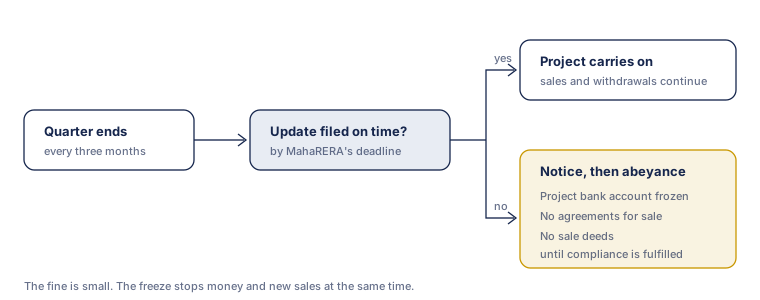
- the listed projects are kept in abeyance
- their bank accounts are frozen
- the promoter is prohibited from executing agreements for sale or sale deeds with buyers, until further compliances are fulfilled
Read those as an operator, not as a compliance officer. A frozen project account means the money already collected from buyers stops moving. A ban on agreements for sale means new sales stop too. Together they cut off cash coming in and cash going out, in the middle of a build. Even the certified withdrawals described in how the RERA 70% account releases money can't happen from a frozen account.
One honest limit: the rows I could read on that page are dated between 2017 and 2024. It looks like a running record of projects acted on over the years, not a live list of this year's 8,212. The mechanism is what matters, and that part is in MahaRERA's own words.
The fine is the cheap part
According to the same Outlook Money report, MahaRERA gave the flagged developers 60 days to respond, and the actions on the table included cancelling or suspending registration, freezing bank and escrow accounts, restricting advertising or sales, and a ₹50,000 penalty. Construction World reported the same 8,212 figure four days later.
₹50,000 is a rounding error on a residential project. If that were the whole consequence, a missed quarter would be a bad week for the accounts team and nothing more. It isn't the whole consequence. MahaRERA's chairman, Manoj Saunik, was quoted saying the authority "will not hesitate to cancel or keep such project's registration in abeyance". The abeyance page shows what that word means in practice.
The ban on agreements for sale hurts more than it first sounds. Under Section 13 of the RERA Act, you can't take more than 10% of a flat's cost from a buyer before a registered agreement for sale exists. So a project that can't sign agreements is a project that, for new buyers, is capped at booking amounts. I wrote about that cap separately in why your booking amount stops at 10%.
Why a quarter gets missed
The information for a quarterly update is rarely the hard part. Site progress exists, the sales team knows what was booked, and accounts know what came in. The update gets missed because nobody owns it. It sits between the site engineer, the sales head and the CA, and each of them assumes one of the others is handling it.
The second reason is that it is treated as paperwork, filed when someone remembers, instead of as a deadline with a consequence. GST returns don't get forgotten, because everyone knows what happens if they are. The QPR deadline deserves the same treatment, and the abeyance page is the reason why.
What I would do this quarter
Three things, none of them software:
- Name one owner. One person, not a department, who files the update and is answerable if it is late. Write the name down.
- Put the deadline next to GST. As reported for the January to March 2026 quarter, it was 20 April. Put each quarter's date in the same calendar your accounts team uses for tax dates, with a reminder two weeks earlier.
- Keep progress current through the quarter. The update is easy when site progress has been recorded as work happened. It is a scramble when someone has to reconstruct three months of site work in the last week. If your progress is tracked in the same categories MahaRERA uses, most of the work is already done before the quarter ends.
If you have already received a notice, read it for the exact response window and what it asks for, and answer inside that window. Sixty days, if that is what yours says, goes faster than you think when the person who should answer is also running a site.
The fine is the number in the headline. The account freeze is the number in your cash flow, and it is the one to plan around.
Sources
- Abeyance, frozen bank accounts, and the ban on agreements for sale and sale deeds: MahaRERA, Due to Non Compliance of QPR
- 8,212 projects flagged out of 33,029, the January to March 2026 quarter, the 20 April 2026 deadline, 60 days to respond, the listed actions and the ₹50,000 penalty, and the chairman's quote: as reported by Outlook Money, 4 May 2026
- 8,212 notices: as reported by Construction World, 8 May 2026
This is commentary, not legal advice. Check the exact deadline and requirements against MahaRERA's current orders and any notice you have received.